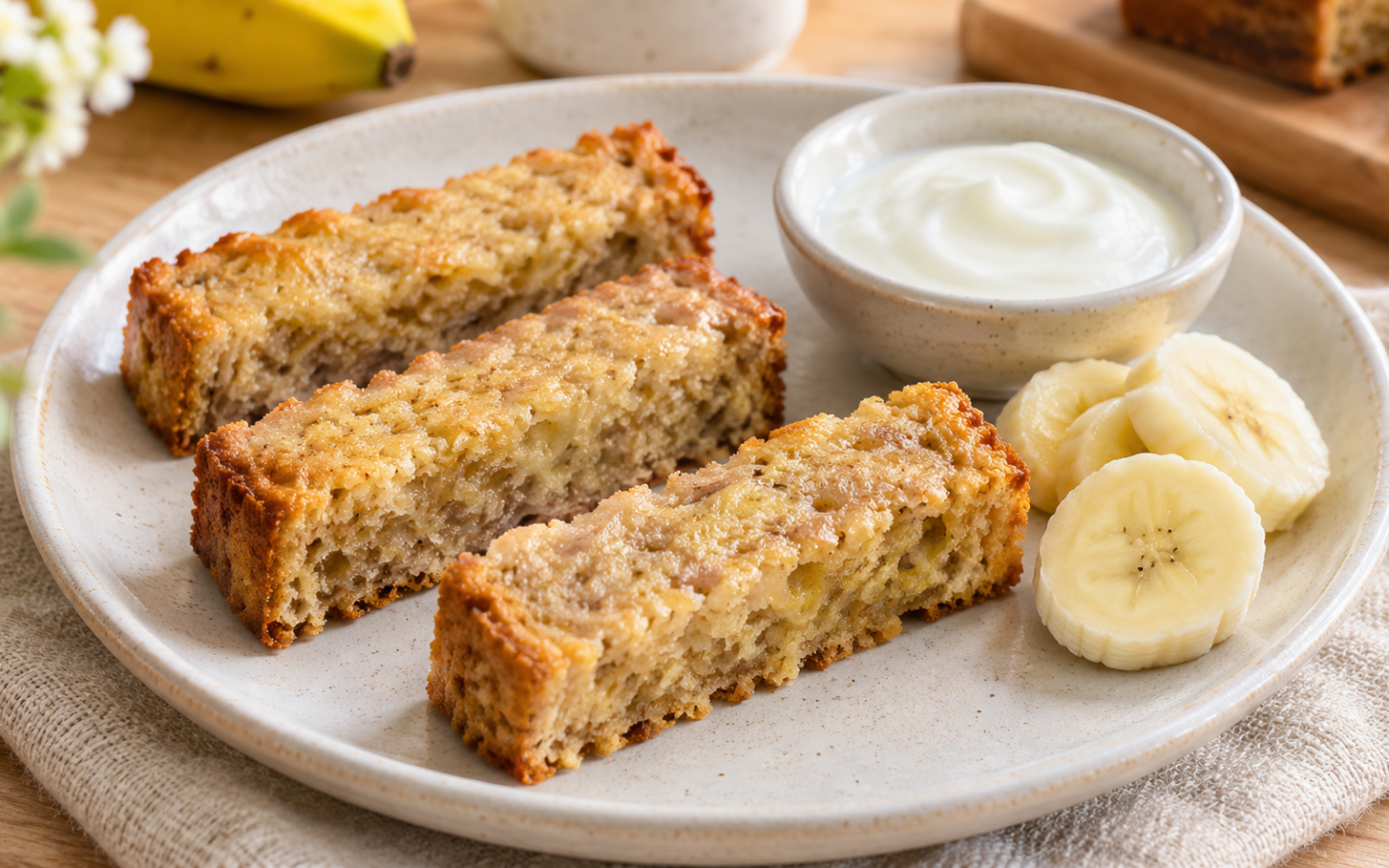
banana bread sticks for babies are soft finger-food batons made from ripe banana, eggs, oats, and flour, with no added sugar. Unlike hard twice-baked rusks, these sticks keep a moist crumb that can be squashed easily between adult fingers. That texture is more suitable for a young eater who is developmentally ready for self-feeding.
This recipe focuses on food quality and handling, not claims that one age fits every child. Readiness depends on development, posture, oral skills, and professional guidance. The method explains batter consistency, full baking, safe cutting, texture testing, supervised serving, allergens, and freezing.
banana bread sticks for babies: recipe overview
| Prep time | 15 minutes |
|---|---|
| Bake time | 30–38 minutes |
| Cooling time | 30 minutes |
| Total time | About 1 hour 20 minutes |
| Yield | 18 thick sticks |
| Oven | 350°F / 175°C |
Read the complete method before beginning and prepare every component in advance. The times are planning estimates; ingredient temperature, pan material, appliance calibration, and portion thickness all affect the finish. Use the visual, texture, and temperature cues in the instructions rather than treating the clock as the only test.
Why this recipe works
- Very ripe bananas provide moisture and sweetness without honey or added sugar.
- Eggs set the crumb while yogurt and oil prevent a dry, hard texture.
- Oats add body and mild flavor without turning the sticks into brittle biscotti.
- Baking once, cooling fully, and cutting thickly creates graspable pieces that remain soft.
The method is organized around moisture, heat, and sequencing. Each pause has a purpose: it may stabilize a mixture, protect texture, or make the final seasoning easier to judge. Following the order is more useful than adding extra ingredients to compensate for a technical problem.
Ingredients and their roles
Weights are the most repeatable measures where provided. Read labels for allergens and sodium, especially on preserved seafood, broth, bread, condiments, and prepared dairy. Bring only the ingredients specified to room temperature; keep fish, meat, eggs, and other perishable foods safely chilled until needed.
- 3 very ripe medium bananas, about 1 1/4 cups mashed: Choose heavily speckled fruit that smells sweet but is not fermented or moldy.
- 2 large eggs: Eggs bind and set the loaf; introduce allergens according to the child’s clinical guidance.
- 1/3 cup plain full-fat yogurt: Yogurt makes the crumb tender. Use unsweetened pasteurized dairy or an appropriate alternative.
- 3 tablespoons neutral oil or melted unsalted butter: A modest amount keeps refrigerated sticks from becoming tough.
- 1 cup / 125 g all-purpose flour: Spoon and level or weigh; excess flour makes a dense, dry loaf.
- 3/4 cup / 70 g finely ground rolled oats: Pulse ordinary oats into a coarse flour so long flakes do not weaken slices.
- 1 1/2 teaspoons baking powder and 1/2 teaspoon cinnamon: Leavening lightens the crumb; cinnamon is optional flavor, not a health treatment.
- 1 teaspoon vanilla and a pinch of salt: Vanilla supports banana aroma; salt may be omitted for a very young eater if preferred.
Ingredient selection and preparation
Use banana as the sweetener
Brown speckles indicate starch converting to sugar. Mash until mostly smooth, measuring after peeling. One small banana is not enough for this formula; low fruit volume produces dry sticks. Do not add honey for children under 12 months because of infant botulism risk.
Choose a soft flour balance
All whole-wheat flour can make the crumb coarse and thirsty. For more whole grain, replace up to half the all-purpose flour with whole-wheat pastry flour. Oats should be finely ground, not left as large chewy flakes.
Plan allergen introduction
The recipe contains egg, wheat, and dairy. It is not the place to introduce several unfamiliar allergens simultaneously without appropriate guidance. Families managing eczema, known allergy, feeding difficulty, prematurity, or another medical concern should consult the child’s clinician.
Finish all chopping, draining, zesting, weighing, and pan preparation before active cooking starts. Good mise en place prevents a delicate component from overcooking while another is still being measured and reduces cross-contamination between raw and ready-to-eat ingredients.
How to make soft banana bread sticks for babies
-
Heat oven and line pan
Heat oven to 350°F / 175°C. Line an 8-inch square metal pan with parchment, leaving handles. Lightly grease exposed sides. A square pan gives more uniform sticks than a tall loaf pan and shortens baking.
-
Mash and measure banana
Mash bananas in a wide bowl until only tiny soft pieces remain. Measure 1 1/4 cups. If significantly short, add more banana rather than milk; changing the liquid type alters sweetness and structure.
-
Mix wet ingredients
Whisk eggs, yogurt, oil, and vanilla into banana until uniform. The mixture may look slightly curdled from yogurt but should have no large egg-white strands.
-
Combine dry ingredients
Whisk flour, ground oats, baking powder, cinnamon, and optional salt in another bowl. Break up leavening lumps so no bitter pockets remain.
-
Fold briefly
Add dry ingredients to wet and fold just until no flour pockets remain. Batter should be thick and spreadable. Do not beat smooth; overmixing develops gluten and makes sticks rubbery.
-
Bake fully
Spread evenly and bake 30 to 38 minutes until the center springs back, a tester has moist crumbs rather than wet batter, and the internal temperature is about 200°F / 93°C. Cover loosely only if the top darkens early.
-
Cool completely
Rest in pan 10 minutes, lift to a rack, and cool at least 30 minutes. Warm banana bread is fragile and smears when cut; complete cooling gives clean edges and makes texture easier to assess.
-
Cut and test texture
Trim only very firm edges if needed. Cut into 18 batons roughly two adult fingers long and one adult finger wide. Press a center between thumb and forefinger: it should squash easily without snapping into a hard shard.
-
Serve responsively
Seat the child upright and alert, place one or two appropriately sized sticks on the tray, and supervise continuously. Let the child control bringing food to the mouth. Modify size and softness for individual ability and follow the family’s professional feeding guidance.
Technique notes for dependable results
Soft is the goal
The old twice-baked method creates a hard rusk and is not used here. Browning at edges is fine, but the center must stay moist and compressible. Toasting is an adult variation, not the default for babies.
Judge the batter
Bananas vary in water. A correct batter spreads slowly. If pourable like pancake batter, fold in one tablespoon flour; if stiff like dough, add one tablespoon yogurt. Make minimal adjustments.
Bake the center safely
Banana can make a tester look moist even when baked. Combine cues: springing center, no wobble, 200°F internal temperature, and a tester without raw streaks. Eggs and flour must be fully cooked.
Cut for the eater
Finger-food dimensions are not a universal guarantee against choking. Shape, texture, oral skill, seating, and supervision all matter. Adapt with advice from a qualified pediatric feeding professional when uncertain.
Common mistakes and fixes
Gummy center
The pan was too small, banana excessive, or bake short. Return the uncut slab to the oven and verify temperature. Never serve raw gummy batter.
Dry hard sticks
Too much flour or a second long bake removed moisture. Weigh flour, bake once, and store after cooling.
Crumbly pieces
The loaf may be warm, overbaked, or missing measured egg. Cool fully and test every batch before offering.
Sticks become sticky
Warm bread was sealed or fruit moisture condensed. Cool uncovered, then refrigerate in a lined container and replace damp lining.
Variations and substitutions
Dairy-free
Use unsweetened fortified soy yogurt if appropriate for the child and allergy plan. Coconut yogurt changes nutrition and may be low in protein.
Egg-free
A tested egg-free version requires reformulation. Two flax eggs can produce a fragile gummy crumb, so do not assume a casual swap is suitable for self-feeding.
Blueberry
Fold in 1/3 cup blueberries that have been squashed or finely chopped for the eater’s ability. Whole round berries can be a choking hazard.
Adult toasted sticks
Adults and older capable eaters may toast refrigerated sticks lightly and add nut butter. Do not create a hard dry texture for a baby.
Make one substitution at a time the first time you vary the recipe. That preserves the core ratio and makes the effect of the change clear. Several simultaneous substitutions can alter moisture, salt, fat, and cooking time in ways that are difficult to diagnose.
Detailed cook’s notes
Readiness over calendar age
A child should be able to sit upright with stable head control, reach for food, and manage food in the mouth according to professional guidance. Marketing a recipe as “six-month” food cannot replace an individual assessment.
Gagging and choking
Gagging can be noisy; choking may be silent and prevents effective breathing. Caregivers should learn age-appropriate first aid from a qualified provider and avoid relying on a recipe page during an emergency.
Whole nuts and thick spreads
Do not add chopped nuts to baby sticks. If nut introduction is appropriate, use a small amount of smooth thinned nut butter according to allergy guidance; a thick spoonful can be difficult to manage.
Sugar and sodium
Ripe banana supplies ample sweetness. There is no culinary need for brown sugar. Optional salt is tiny, but families can omit it. Check yogurt alternatives and baking powder labels.
Batch consistency
Record banana weight, pan, and bake time when a batch works. Fruit size changes substantially, so volume or weight after mashing is more reliable than “three bananas” alone.
Portion perspective
One stick is a serving unit, not a required intake. Appetite changes by child and day. Offer alongside other suitable foods and follow hunger and fullness cues rather than encouraging a fixed count.
Recheck after chilling
Cold storage firms starch and fat, so a stick that was soft when warm may feel denser from the refrigerator. Before serving, thaw or warm as intended, let it reach a safe temperature, and repeat the finger-squash test through the center. If it has dried into a firm piece, soften with plain yogurt or choose another food.
Serving and pairing
Serve plain, with a thin smear of smooth yogurt, or beside suitably prepared soft fruit. The child must be seated upright and watched at arm’s reach. Avoid distraction, eating in a moving car or stroller, and forcing food into the mouth.
For a more complete meal, pair with an age-appropriate iron-rich food and fruit or vegetable according to professional guidance. Banana bread alone should not displace a varied diet. Offer water in the manner recommended for the child.
Make-ahead, storage, and reheating
Cool fully, refrigerate in a lined airtight container up to 4 days, or freeze separated on a tray before transferring to a freezer container for up to 2 months. Label the date and allergens. Discard food handled and partially eaten by the child rather than returning it to storage.
Thaw overnight in the refrigerator or use a microwave briefly, then cool and test every part before serving. Hot spots can burn. The stick should be warm or room temperature and still squash easily; do not crisp it for a baby.
Food safety and allergen notes
Contains egg, wheat, and milk unless specifically reformulated. No food shape eliminates choking risk. Serve only to a developmentally ready child seated upright under direct adult supervision. Do not use honey under 12 months, whole nuts, hard dried fruit, or hard twice-baked sticks.
Nutrition values are estimates based on typical products and the stated yield. Brands, trimming, substitutions, retained cooking fat, and actual portions change the result; the estimate is not medical advice.
Frequently asked questions
What age are banana bread sticks for?
There is no single age that guarantees readiness. Use developmental signs and the child’s pediatric or feeding guidance, especially with prematurity, oral-motor concerns, or allergy risk.
Why is there no added sugar?
Very ripe bananas provide sweetness and moisture. Added sugar is unnecessary for structure in this formula and does not improve feeding safety.
Can I make them crispy?
For adults or older skilled eaters, yes. For babies, this recipe intentionally stays soft and squashable; hard rusks may break into difficult pieces.
Can I use only oat flour?
Not as a direct swap. Oat flour lacks gluten and can create a fragile gummy bar. Use a tested oat-specific recipe when wheat must be avoided.
How do I freeze individual sticks?
Freeze cooled sticks in one layer until firm, then transfer to a labeled container. This prevents a frozen block and allows single portions.
Can I add nuts?
Do not add chopped or whole nuts. Discuss allergen introduction with a clinician and use only an appropriate smooth preparation if advised.
Final cooking note
Soft banana bread sticks for babies are successful when the crumb is fully baked yet easily squashable. Measure ripe banana, avoid overmixing, cool before cutting, and test each batch. Most importantly, match the food to the individual child’s development and provide upright, attentive supervision every time.