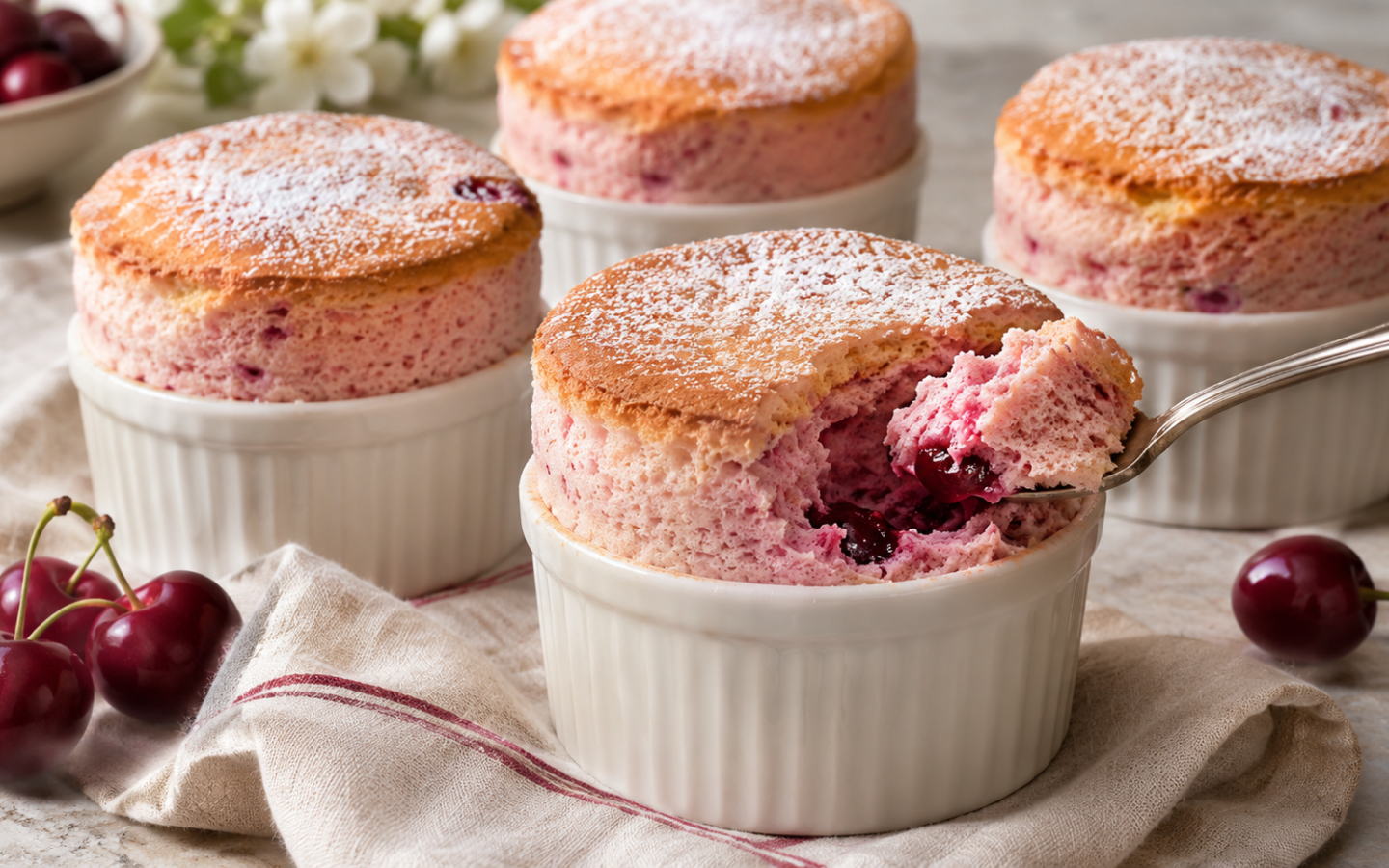
fresh cherry soufflé turns ripe or frozen cherries into an airy individual dessert with genuine fruit character. The base is cooked until thick enough to support whipped egg whites, then folded gently and baked in sugar-coated ramekins. The result rises high, colors naturally, and tastes bright rather than like a heavily sweetened cake.
Soufflé is time-sensitive but not mysterious. A smooth fruit base, clean bowl, medium-stiff glossy meringue, upward ramekin coating, and fully preheated oven do most of the work. This version makes six modest portions so the centers set before the tops become dry.
fresh cherry soufflé: recipe overview
| Prep time | 30 minutes |
|---|---|
| Cook time | 14–17 minutes |
| Total time | About 50 minutes |
| Yield | 6 individual soufflés |
| Oven | 375°F / 190°C |
| Difficulty | Intermediate |
Read the complete method before beginning and prepare every component in advance. The times are planning estimates; ingredient temperature, pan material, appliance calibration, and portion thickness all affect the finish. Use the visual, texture, and temperature cues in the instructions rather than treating the clock as the only test.
Why this recipe works
- Cooking cherry purée with cornstarch removes excess water and creates a base strong enough to hold air.
- A small amount of lemon sharpens the fruit while salt and vanilla round its flavor.
- Sugar is added gradually to egg whites, producing a glossy foam that stretches in the oven instead of breaking.
- Butter and sugar brushed upward inside straight-sided ramekins encourage an even climb and make release easier.
The method is organized around moisture, heat, and sequencing. Each pause has a purpose: it may stabilize a mixture, protect texture, or make the final seasoning easier to judge. Following the order is more useful than adding extra ingredients to compensate for a technical problem.
Ingredients and their roles
Weights are the most repeatable measures where provided. Read labels for allergens and sodium, especially on preserved seafood, broth, bread, condiments, and prepared dairy. Bring only the ingredients specified to room temperature; keep fish, meat, eggs, and other perishable foods safely chilled until needed.
- 12 ounces / 340 g pitted cherries: Fresh or thawed frozen fruit works; drain thawed fruit but keep two tablespoons of its juice.
- 1/3 cup / 65 g sugar, divided: Part sweetens the fruit and part stabilizes the egg whites. Adjusting far below this amount weakens both flavor and foam.
- 1 tablespoon lemon juice and 1 teaspoon vanilla: Lemon balances sweetness; vanilla softens the sharper edges without hiding cherry.
- 2 tablespoons / 16 g cornstarch: Starch binds cherry juice into a smooth, spoon-coating base.
- 4 large egg whites, about 120 g: Use fresh whites with no trace of yolk; room-temperature whites foam readily.
- 1/8 teaspoon cream of tartar and a pinch of salt: Acid supports the foam. Lemon juice cannot be added casually to the whites because extra liquid changes the ratio.
- 1 tablespoon softened butter and 2 tablespoons sugar for ramekins: The coating helps the batter climb and gives the edge a delicate crust.
- Powdered sugar, optional: A very light dusting is added only after baking and immediately before serving.
Ingredient selection and preparation
Choose flavorful cherries
Dark sweet cherries create a rounded dessert; tart cherries produce brighter acidity and may need another teaspoon or two of sugar. Frozen cherries are often excellent because they are packed ripe. Maraschino cherries are not a direct substitute: their syrup, dye, and high sugar make the base much sweeter and wetter.
Separate eggs carefully
Cold eggs are easier to separate, but the whites whip best after standing in a covered clean cup for about 20 minutes. Separate each egg over a small bowl before adding it to the larger measure; one broken yolk then does not contaminate the whole batch. Save yolks for custard.
Prepare straight-sided ramekins
Six 6-ounce ramekins give reliable individual portions. Brush softened butter from bottom to rim in vertical strokes, coat completely with sugar, tap out excess, and avoid touching the interior afterward. Set them on a heavy sheet pan before mixing the foam.
Finish all chopping, draining, zesting, weighing, and pan preparation before active cooking starts. Good mise en place prevents a delicate component from overcooking while another is still being measured and reduces cross-contamination between raw and ready-to-eat ingredients.
How to make fresh cherry soufflé
-
Heat the oven and prepare pans
Place a rack in the lower-middle position and heat the oven to 375°F / 190°C for at least 20 minutes. Butter and sugar the ramekins, arrange them on a room-temperature sheet pan, and clear a direct path to the oven so the finished batter does not wait.
-
Make the cherry purée
Blend cherries, 3 tablespoons sugar, lemon juice, vanilla, and salt until smooth. For an exceptionally refined texture, press through a medium sieve; leaving fine pulp creates stronger fruit character. Measure about 1 1/4 cups and place it in a saucepan.
-
Cook the fruit base
Whisk cornstarch with 2 tablespoons cool cherry liquid or water until smooth. Whisk it into the purée and cook over medium heat, stirring continuously, until the mixture bubbles and becomes thick enough that a spatula leaves a brief track, about 3 to 5 minutes. Simmer 30 seconds to remove raw starch flavor.
-
Cool to lukewarm
Transfer the base to a wide bowl, press parchment directly on the surface, and cool until lukewarm rather than cold, about 15 minutes. A hot base deflates whites; a refrigerator-cold base is stiff and difficult to fold. Measure one cup for the soufflé and reserve any extra as sauce.
-
Whip the egg whites
In a spotless bowl, beat whites at medium speed until foamy. Add cream of tartar, then increase to medium-high. Rain in the remaining sugar gradually. Stop at glossy medium-stiff peaks: the tip should bend slightly but the foam should not slide in the bowl or look dry and clumpy.
-
Lighten and fold
Whisk one-quarter of the meringue into the cherry base to loosen it. Add half the remaining foam and fold with a broad spatula, cutting through the center, sweeping along the bottom, and turning the bowl. Fold in the final portion only until no large white streaks remain.
-
Fill and clean the rims
Spoon batter to the top of each ramekin, level gently, and run a clean thumb around the inside rim to make a shallow channel. Wipe drips from the outside. Do not bang the tray; impact knocks air from the foam.
-
Bake and serve immediately
Bake without opening the door for 13 minutes, then observe through the glass. Continue until the soufflés are well risen, lightly colored, and wobble slightly as a unit, usually 14 to 17 minutes. Serve on heat-safe plates immediately; they begin settling as soon as they leave the oven.
Technique notes for dependable results
Recognize the right base
The cooked purée should be glossy and thick but still foldable. If watery, it cannot support the foam; cook another minute. If rubbery after cooling, whisk in a teaspoon of cherry juice. Correcting the base before folding is far safer than stirring liquid into finished batter.
Stop whipping at the right moment
Underwhipped whites cannot hold enough gas, while overwhipped whites become granular and resist smooth folding. Medium-stiff peaks look satiny, form clear tracks from the whisk, and retain flexibility. When in doubt, stop early and finish with a few manual whisk strokes.
Fold for uniformity, not perfection
Large white pockets create uneven holes, but endless folding destroys lift. Use confident broad strokes and rotate the bowl. The finished batter should be uniformly pale cherry with a mousse-like consistency that slowly settles when spooned.
Understand the center
A properly baked fruit soufflé is moist and tender, not liquid and not cake-dry. An instant-read thermometer inserted discreetly near the center should reach about 160°F / 71°C for egg safety, though the small hole affects presentation. Test one ramekin when precision matters.
Common mistakes and fixes
No rise
Likely causes are grease in the bowl, yolk in the whites, a thin base, overfolding, or a cool oven. Review preparation rather than adding more leavener; soufflé rises from steam and trapped air, not baking powder.
Leaning or uneven tops
Uneven ramekin coating, batter smeared on one rim, a warped tray, or strong convection can push the rise sideways. Use static heat when possible and space ramekins evenly.
Wet raw centers
The fruit base may have been too loose or the bake too short. Return the tray promptly for 2 to 3 minutes. Do not mistake a creamy, set center for raw batter.
Dry, cracked texture
The whites were overwhipped or the soufflés overbaked. Small cracks are normal, but a cottony center signals excessive heat exposure. Begin checking at the earlier time.
Variations and substitutions
Tart cherry version
Use unsweetened tart cherries and increase fruit-base sugar by 1 to 2 tablespoons after tasting. Keep the meringue sugar unchanged because it serves a structural purpose.
Cherry-almond aroma
Add only 1/8 teaspoon pure almond extract to the base. It is powerful and can make the dessert taste artificial; disclose the flavoring when serving someone with concerns about almond products.
Dairy-free dessert
The batter is naturally dairy-free except for ramekin butter. Use a neutral dairy-free baking fat that coats reliably, and confirm all products meet the relevant allergy needs.
One large soufflé
A 1 1/2-quart dish can work, but it needs roughly 25 to 32 minutes and the center is harder to judge. Individual ramekins are more consistent and easier to serve promptly.
Make one substitution at a time the first time you vary the recipe. That preserves the core ratio and makes the effect of the change clear. Several simultaneous substitutions can alter moisture, salt, fat, and cooking time in ways that are difficult to diagnose.
Detailed cook’s notes
Make-ahead boundary
Cook the cherry base up to 2 days ahead, cover its surface, and refrigerate. Bring it back to cool room temperature and whisk smooth before folding. Prepare ramekins several hours ahead and chill them. Whip and fold only shortly before baking.
Oven calibration
A 25°F error changes rise and setting significantly. An inexpensive oven thermometer reveals whether the displayed temperature is accurate. Preheating until the signal sounds may be insufficient; allow the oven walls and sheet pan area to stabilize.
Serving logistics
Have plates, spoons, napkins, and guests ready before the soufflés enter the oven. Dessert sauce should already be portioned. A soufflé settling naturally is not failure, but unnecessary waiting sacrifices its most dramatic texture.
Flavor concentration
Cooking cherries intensifies both sweetness and acidity. Taste the cooled base rather than the hot mixture, because temperature affects perception. It should taste slightly stronger than the desired final dessert; the neutral egg whites dilute it.
Ramekin fill level
Filling level controls appearance and portion. Batter flush with the rim produces a tall cap; leaving a large gap creates a lower rise. Level without compressing and keep the rim channel clean.
Why no yolks or cream
A pure fruit base and egg-white foam keep the dessert light and the cherry vivid. Yolks and cream can enrich a custard soufflé but require a different starch and liquid balance; adding them here would make the batter heavy.
Serving and pairing
Carry ramekins on small plates with folded napkins so guests recognize that the ceramic is hot. Offer reserved cherry sauce, crème fraîche, or lightly whipped cream at the side, not poured over the top before presentation. A few fresh pitted cherries can garnish the plate but should never hide the rise.
The dessert is sweet and aromatic, so pair it with unsweetened coffee, black tea, or a small spoonful of tangy cultured cream. Avoid a heavy chocolate sauce on the first serving; it overwhelms the cherry and makes the delicate structure seem less distinct.
Make-ahead, storage, and reheating
Soufflés are best eaten immediately. The cooked cherry base keeps refrigerated up to 2 days. Baked leftovers may be chilled within 2 hours and kept up to 2 days, but they will collapse and become denser; cover only after fully cool to limit condensation.
Reheat a baked soufflé at 325°F / 165°C for 7 to 10 minutes until hot, understanding that it will not regain its original height. A collapsed portion is also pleasant cold with yogurt, but it should not be presented as a newly risen soufflé.
Food safety and allergen notes
This recipe contains egg and may contain milk in the ramekin coating or accompaniment. Use clean equipment, keep raw egg separate from ready-to-eat food, and bake the egg-white center to a safe set. Ramekins remain dangerously hot after the delicate top begins to cool.
Nutrition values are estimates based on typical products and the stated yield. Brands, trimming, substitutions, retained cooking fat, and actual portions change the result; the estimate is not medical advice.
Frequently asked questions
Can I use frozen cherries?
Yes. Thaw completely, drain, and use some drained juice to dissolve cornstarch. Weigh the fruit after pitting and before cooking. Frozen cherries often produce excellent color and consistent flavor.
Why did my soufflé fall?
All soufflés settle because hot expanded air and steam contract outside the oven. Rapid collapse before serving can indicate an underbaked center or weak foam, but gradual settling is normal physics, not a recipe defect.
Can I open the oven door?
Avoid opening during the first 13 minutes because the temperature drop can interrupt expansion before the structure sets. After that, open briefly only if a visual check through the glass is impossible.
Can I reduce the sugar?
The fruit-base portion can be adjusted slightly after tasting. Keep the sugar whipped into the whites because it stabilizes foam and affects tenderness. Large reductions require a recipe specifically developed for them.
Do I need cream of tartar?
It provides consistent acidity for the egg whites. A clean copper bowl can also stabilize foam, but simply omitting all acid makes the timing less forgiving. Do not substitute baking powder.
Can I prepare the complete batter ahead?
No. Once folded, the foam slowly loses air and the fruit base draws moisture from it. Prepare the components ahead, then whip, fold, fill, and bake close to serving.
Final cooking note
A dependable fresh cherry soufflé comes from managing water and air: thicken the fruit enough, build flexible glossy foam, fold only until uniform, and bake in a fully heated oven. Organize service before mixing, then enjoy the dessert at the moment when its warm cherry aroma and feather-light center are most expressive.