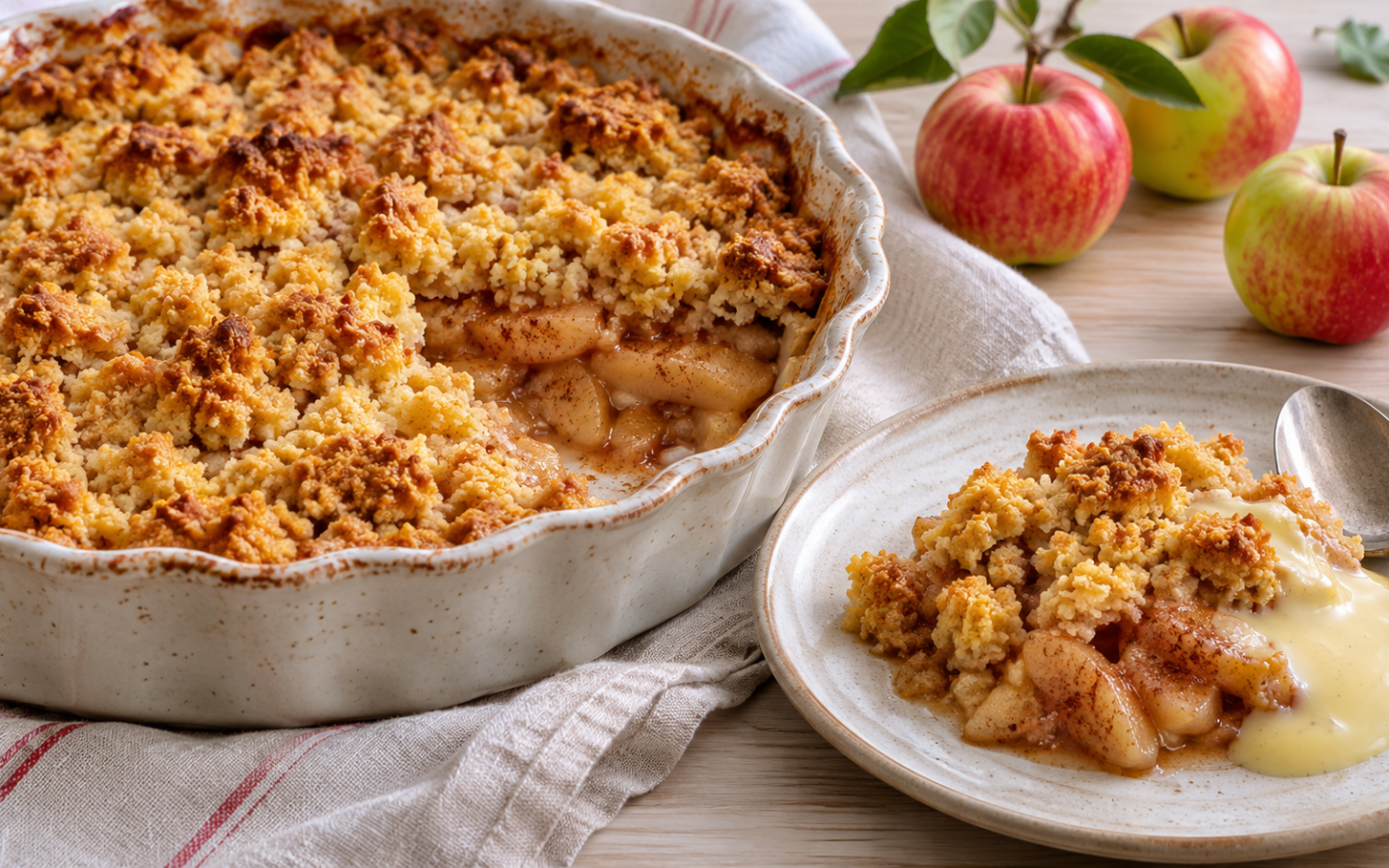
Swedish apple pie (äppelpaj) is less about a pastry shell than the contrast between tender tart apples and a deeply golden buttery topping. This version follows the familiar crumble-style approach often served at a Swedish fika table: no rolling pin, no bottom crust, and no need to force the warm dessert into perfect slices.
The recipe controls apple moisture with an appropriate variety, a small amount of starch, and a shallow baking dish. Cold butter is worked into flour, oats, sugar, and salt until the mixture contains both fine crumbs and larger clusters, producing a top that is crisp rather than sandy or greasy.
Swedish apple pie (äppelpaj): recipe overview
| Prep time | 25 minutes |
|---|---|
| Bake time | 40–50 minutes |
| Rest time | 20 minutes |
| Total time | 1 hour 35 minutes |
| Yield | 8 servings |
| Pan | 9-inch / 23 cm baking dish |
This overview is a planning guide rather than a cue to rush. Read the full method once, prepare every component, and use the visual and texture checks in the instructions. Ovens, pans, produce, and portion sizes vary, so reliable cooking depends on observing the food as well as watching the clock.
Why this recipe works
- Tart, firm apples keep their identity after baking and balance the sweet topping.
- A little cornstarch captures released juice without turning the filling gummy.
- Oats add irregular crisp edges while flour gives the crumble enough structure.
- A short rest lets bubbling juices settle and the topping regain crispness.
The formula is deliberately specific about moisture, heat, and sequencing. Those three variables decide whether the finished dish has contrast and balance or simply tastes flat. Nothing here is included only for decoration: each ingredient and each pause in the method has a practical job.
Ingredients and what each one does
Measure the ingredients before starting. When a weight is supplied, it is the most repeatable option; cup measures remain useful for cooks without a scale. Read labels if an allergy or dietary restriction matters, because prepared sauces, broths, breadcrumbs, and cultured products can vary by brand.
- 2 1/4 pounds / 1 kg apples: Use firm sweet-tart apples such as Granny Smith, Braeburn, Pink Lady, Ingrid Marie, or a mixture.
- 2 tablespoons sugar, 1 tablespoon lemon juice, and 1 1/2 teaspoons cinnamon: These season the fruit without masking its natural character.
- 1 tablespoon cornstarch and a pinch of salt: Starch lightly binds juice; salt sharpens the apple flavor.
- 1 cup / 125 g all-purpose flour: Flour forms the structural base of the crumble.
- 3/4 cup / 70 g rolled oats: Use old-fashioned rolled oats, not instant oatmeal packets.
- 2/3 cup / 135 g light brown or white sugar: Brown sugar gives a caramel note; white sugar makes a slightly crisper top.
- 1/2 teaspoon baking powder and 1/4 teaspoon salt: A small amount of lift keeps the topping from becoming compact.
- 10 tablespoons / 140 g cold unsalted butter: Cut it into cubes and keep it cold until mixing.
- 1 teaspoon vanilla sugar or vanilla extract: Vanilla is optional but especially good when the pie is served without sauce.
Ingredient selection and preparation
Use more than one apple when possible
A mixture creates flavor depth: a firm tart variety supplies structure and acidity, while an aromatic sweeter apple softens around the edges. Avoid apples that are already mealy. Weigh after coring for the most consistent filling, and slice about 1/4 inch thick so the fruit cooks before the topping burns.
Understand Swedish äppelpaj
Swedish home baking includes several apple-pie styles, from crumbly smulpaj to batter-topped versions. This recipe is a crisp crumble rather than an American double-crust pie. The Swedish name äppelpaj simply means apple pie, so variation is normal rather than evidence that only one formula is authentic.
Keep the butter cold
Cold pieces create pockets that melt in the oven, leaving a rugged crumb. Soft butter coats flour completely and can make a dense, greasy lid. If the kitchen is warm, chill the assembled topping for 10 minutes while preparing the apples.
Complete the cutting, draining, cooling, or tempering described above before heat is involved. This small mise-en-place habit prevents overcooking while another ingredient is still being prepared and makes the final seasoning easier to judge.
How to make swedish apple pie (Äppelpaj)
-
Heat the oven and prepare the dish
Set a rack in the center and preheat to 375°F / 190°C. Butter a 9-inch baking dish and place it on a rimmed sheet pan to catch any bubbling juice. A ceramic, glass, or metal dish works; metal browns faster, while heavy ceramic retains heat longer.
-
Prepare the apples
Peel if desired, then quarter, core, and slice the apples evenly. Toss with lemon juice, 2 tablespoons sugar, cinnamon, cornstarch, and salt. Spread in the dish, including accumulated juice, and level gently without packing the slices into a solid mass.
-
Mix the dry topping
Whisk flour, oats, sugar, baking powder, salt, and vanilla sugar in a bowl. Break up brown-sugar lumps. Even distribution now prevents salty or powdery patches later, when the butter makes thorough mixing more difficult.
-
Cut in the butter
Add cold butter cubes. Use fingertips, a pastry blender, or two knives to work them into the dry mixture until most crumbs resemble coarse meal but some pea-size clusters remain. Squeeze a handful; it should hold briefly, then break into irregular pieces.
-
Cover the fruit
Scatter topping evenly from the outer edge toward the center. Do not press it flat. Leave its surface craggy so peaks brown and valleys remain tender. If the apples mound high, contain loose crumbs inside the rim rather than letting them burn on the sheet pan.
-
Bake to visual cues
Bake 40 to 50 minutes. The top should be deep golden rather than pale beige, and thick bubbles should appear around several edges. Insert a thin knife into the center; the apples should offer little resistance. Tent loosely with foil only if the top browns before the fruit softens.
-
Rest before serving
Cool on a rack for at least 20 minutes. Resting is part of the recipe: the fruit juice thickens, the intense heat becomes safe, and steam no longer softens the underside of the crumble as aggressively. Serve warm, not scorching.
Technique notes for dependable results
Judge filling by bubbles
A browned top does not prove the center is ready. Look for slow, glossy bubbles at the edge and check apple tenderness in the middle. Starch thickens only after the filling becomes hot enough, so removing the pie too early produces thin juice.
Protect the crumb
Do not stir the topping into the fruit and do not compress it. The exposed surface needs air circulation. If using a very juicy apple, add the measured starch rather than extra flour to the crumble; changing the topping cannot solve liquid beneath it.
Balance sweetness after choosing apples
Taste a slice of apple before adding sugar. Very tart apples may need another tablespoon, while sweet apples may need none beyond the recipe. Vanilla sauce or ice cream adds sweetness at service, so the baked fruit should retain some acidity.
Serve in the Swedish spirit
Warm äppelpaj is often accompanied by vanilla sauce, lightly whipped cream, or vanilla ice cream. A loose vanilla custard flows into the fruit and is especially traditional-feeling; use a moderate amount so the crisp topping remains audible.
Adapt to the baking dish
A shallow wide dish exposes more topping and evaporates apple juice efficiently; a deep dish keeps the filling softer and may require 10 extra minutes. Glass lets you observe bubbling but should not face abrupt temperature changes. Dark metal browns the edge quickly, so begin checking early. Whatever the material, leave headroom for rising bubbles and use a sheet pan underneath.
Let aroma guide final seasoning
Cinnamon should smell integrated with apple, not like raw powder. If the fruit is aromatic, a restrained amount keeps its identity. Lemon is not meant to make the filling taste citrusy; it protects brightness and balances sugar. After baking, a tiny pinch of flaky salt on the crumble can sharpen flavor, but add it only after tasting with the chosen vanilla sauce.
Common mistakes and how to fix them
Watery apple layer
The pie may be underbaked, cut too hot, or made with very juicy apples. Continue baking until the filling bubbles, then rest fully. For future batches, use firm baking apples and measure starch accurately.
Dry, dusty topping
The butter was not distributed or the crumble contained too much flour. Pinch the mixture before baking; it should form clusters. Drizzle no liquid over a baked dusty top, because that makes paste rather than crisp crumbs.
Greasy solid lid
Butter was too warm or the topping was pressed down. Chill it before baking and scatter loosely. Accurate flour and butter weights prevent a ratio problem.
Burnt edges with firm apples
The dish may be too shallow, slices too thick, or rack too high. Tent the top, lower the oven slightly, and continue until the center is tender.
Variations and substitutions
Cardamom apple pie
Add 1/2 teaspoon ground cardamom to the apples or topping. Its citrus-floral character is at home in Scandinavian baking, but too much can overwhelm cinnamon.
Almond crumble
Replace 1/4 cup oats with sliced almonds. This adds crunch and a tree-nut allergen, so label it clearly when serving guests.
Gluten-free adaptation
Use a tested 1:1 gluten-free flour blend and certified gluten-free oats. Texture varies by blend; choose one intended for baking rather than pure nut or coconut flour.
Pear and apple
Replace one-third of the apples with firm pears. Pears soften faster, so slice them slightly thicker and keep enough tart apple to maintain brightness.
Treat every variation as a controlled change. Keep the central ratio and method intact the first time, then adjust one variable on the next batch. That approach makes it clear which change improved the dish and prevents several substitutions from altering texture in unpredictable ways.
Serving ideas
Spoon the warm pie into shallow bowls and add vanilla sauce, softly whipped cream, or a small scoop of vanilla ice cream. For fika, serve modest portions with coffee or tea. The dessert is soft-set and rustic; a spoon is more appropriate than trying to cut rigid wedges.
A lightly sweet custard highlights apple and cinnamon without competing. For contrast, use unsweetened crème fraîche or thick yogurt. Coffee with gentle acidity, black tea, or caffeine-free rooibos all pair well with the buttery crumble.
Make-ahead, storage, and reheating
Cool completely, cover, and refrigerate for up to 4 days. The crumble softens as it absorbs moisture. Freeze individual portions for up to 2 months; thaw overnight in the refrigerator. Do not leave the dairy accompaniment at room temperature.
Warm uncovered at 350°F / 175°C for 12 to 18 minutes until the center is hot and the top has re-crisped. An air fryer works for individual portions in an oven-safe dish. The microwave is quick but softens the crumble.
Food safety and allergen notes
The recipe contains wheat, milk, and oats; variations may add tree nuts. Verify certified products for gluten-related needs. Handle hot bubbling fruit carefully, and use pasteurized dairy for sauces or cream.
Nutrition values are estimates calculated from typical ingredients and the stated yield. They are not medical advice and will change with brands, substitutions, trimming, and actual portion size.
Frequently asked questions
Does äppelpaj have a bottom crust?
Not always. Many Swedish versions are crumble-topped or batter-topped and have no pastry base. This recipe is in the smulpaj family, designed to be spooned rather than cut like a firm American pie.
Should I peel the apples?
Peeling creates the most tender uniform filling. Thin peel can remain for color and texture if the apples are well scrubbed, but tough peel may separate during baking.
Can I assemble it ahead?
Prepare topping and apples separately. Refrigerate topping up to 2 days; toss cut apples with lemon shortly before assembly. Leaving raw topping on sugared fruit overnight pulls out juice and softens the crumbs.
Why use oats if some Swedish recipes do not?
Oats are a common home-style choice, not a universal rule. They give this version extra crispness. Replace them with an equal weight of flour for a finer, more traditional crumb in households that omit oats.
Can I reduce the sugar?
Yes, especially with sweet apples. Reduce topping sugar by up to one-quarter without major structural change. Keep a little sugar on the fruit because it helps draw juice that mingles with cinnamon and starch.
How do I know when Swedish apple pie is done?
Look for a deep-golden top, thick bubbling juice at multiple edges, and center apples that yield to a thin knife. Then rest at least 20 minutes so the filling can settle.
Final cooking note
The character of Swedish apple pie comes from restraint: good apples, enough cinnamon to perfume them, and a crisp topping mixed without overworking. Bake until both the center and the edges are genuinely done, then allow the dish to rest. That patience delivers tender fruit, concentrated juice, and a crumble that stays distinct.