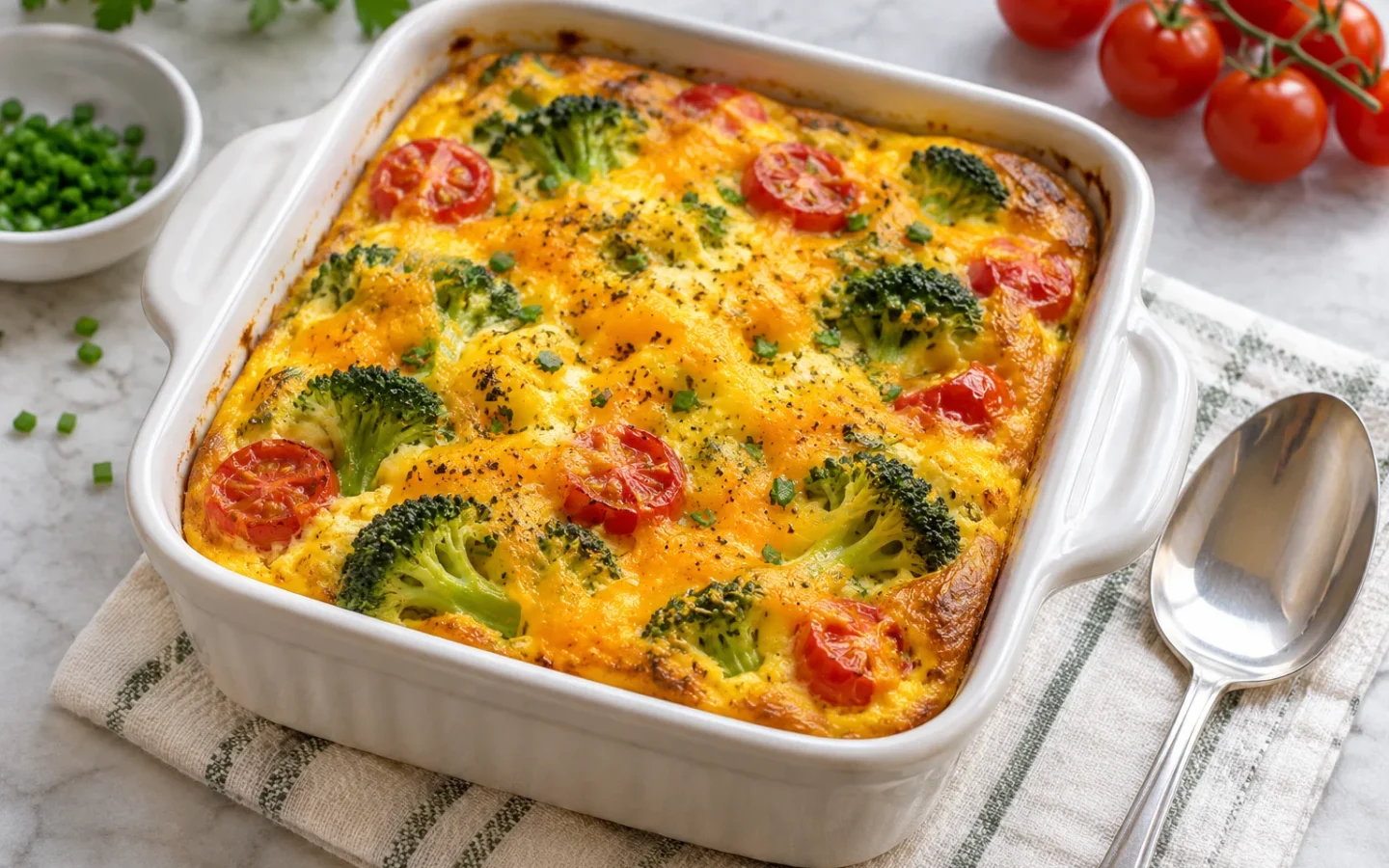
A compact air fryer broccoli egg bake with tender florets, cherry tomatoes, cheddar, and blended cottage cheese for a soft, protein-rich texture.
Introduction
An air fryer broccoli egg bake is a small-format breakfast casserole designed for fast, circulating heat. Broccoli-and-egg videos continued drawing substantial attention across social platforms in November 2026 because the method promises a practical meal with little stovetop work. The appliance does not magically shorten every recipe, but it is well suited to a shallow egg mixture that benefits from a browned top and a gently set center.
The main risk is uneven cooking. Air fryers direct strong heat at the surface, so cheese can brown while cold broccoli and liquid egg remain underneath. This recipe briefly blanches the florets, uses a preheated oven-safe dish, and holds the temperature at 320°F / 160°C rather than blasting the top. Blended cottage cheese adds moisture and protein without leaving obvious curds, while a small amount of cornstarch helps keep water from the vegetables from separating.
Because air-fryer models vary in basket shape, fan strength, and true temperature, the instructions give a range and a doneness target. The center should reach 160°F / 71°C and show no liquid egg when the dish is gently tilted. Resting for five minutes completes the set and makes neat portions possible. The article also covers pan sizing, batch limits, oven adaptation, and safe meal-prep storage.
Time
| Stage | Duration |
|---|---|
| Preparation time | 12 minutes |
| Cooking time | 20 minutes |
| Resting time | 5 minutes |
| Total time | 37 minutes |
Preparation takes about 12 minutes, including a quick broccoli blanch. Air frying generally requires 18 to 22 minutes at 320°F / 160°C, followed by five minutes of rest. A deeper dish, a cold ceramic vessel, or a crowded basket can extend cooking. Begin checking at 16 minutes but do not remove the bake until the center is set and reaches 160°F / 71°C. Reheating individual portions takes three to five minutes at lower heat.
Needed equipment
| Tool | Why it helps |
|---|---|
| 5-to-6-quart air fryer | Provides space around a 7-inch baking dish so hot air can circulate. |
| 7-inch oven-safe ceramic or metal dish | A shallow vessel cooks the center before the cheese overbrowns. |
| Medium saucepan or microwave-safe bowl | Blanches broccoli so it finishes with the eggs. |
| Blender or immersion blender | Smooths cottage cheese into the egg base. |
| Instant-read thermometer | Confirms 160°F / 71°C in the center without guessing from color. |
| Silicone spatula | Transfers the mixture and releases portions without scratching the dish. |
Tags
Air Fryer Breakfast, Broccoli Egg Bake, Cheddar, Meal Prep, High Protein Breakfast.
These tags describe the technique, central ingredients, and serving context. They are navigation aids, not guarantees for medical dietary needs; packaged products must still be checked individually.
Serving Size
This recipe yields 4 servings. Scale ingredients by weight where possible, and remember that pan area, batch size, chilling capacity, and cooking time may need to change when doubling the recipe.
Difficulty Level
Easy. The detailed method identifies the moments that require attention so a first-time cook can understand both the action and the intended result.
Allergen Information
Egg and milk; possible cross-contact from cheese, cottage cheese, and air-fryer accessories Ingredient formulas and cross-contact warnings vary by country and manufacturer. For a serious allergy, read every current label, use clean equipment, and avoid substitutions with uncertain production histories.
Dietary Preference
Vegetarian, gluten-free by ingredient when packaged products are certified, and suitable for lower-carbohydrate meal planning
Course
Breakfast or brunch.
Cuisine
Modern home cooking. This label describes the recipe’s culinary frame and inspiration without claiming that a modern adaptation represents every regional or traditional version.
Ingredients
| Ingredient | Amount | Selection and purpose |
|---|---|---|
| Broccoli florets | 250 g / about 3 cups small florets | Cut evenly and include tender peeled stem pieces. |
| Large eggs | 6 | Provide the main structure; use pasteurized eggs when medically advised. |
| Cottage cheese | 150 g / 2/3 cup | Two-percent or full-fat blends most smoothly. |
| Whole milk | 60 ml / 1/4 cup | Loosens the custard without making it watery. |
| Cornstarch | 2 tsp | Helps bind vegetable moisture and stabilizes the tender set. |
| Sharp cheddar | 100 g / 3 1/2 oz, grated | Reserve one-quarter for the top. |
| Cherry tomatoes | 100 g / 2/3 cup, halved | Place cut-side up to limit juice in the custard. |
| Scallions | 2, thinly sliced | Use white and green parts. |
| Olive oil | 1 tsp | Greases the dish and supports edge browning. |
| Dijon mustard | 1 tsp | Adds acidity and depth without making the bake taste mustardy. |
| Garlic powder | 1/2 tsp | Distributes more evenly than raw garlic in the short cook. |
| Smoked paprika | 1/4 tsp | Optional; use lightly so it does not dominate broccoli. |
| Fine sea salt | 1/2 tsp | Cheddar contributes additional sodium. |
| Black pepper | 1/4 tsp | Freshly ground. |
Measuring and substitution strategy
Read the entire table before shopping. The notes explain function as well as quantity, which matters when making substitutions. Replace like with like: preserve fat with fat, acidity with acidity, and structural dry ingredients with tested equivalents. Spoon measures are level US measures. When both mass and volume appear, use mass for the most repeatable result.
Prepare and measure every ingredient before heat begins. This keeps fast steps from stalling and prevents accidental double additions. If an ingredient has a variable intensity—such as chile paste, miso, coffee concentrate, or flavored liqueur—taste it alone and begin at the lower end of the suggested adjustment.
Instructions
-
1. Choose a safe dish
Confirm that the baking dish is explicitly oven-safe and fits inside the air-fryer basket with space around the sides. It must not touch the heating element or block all airflow. Avoid lightweight paper liners for this liquid recipe because they can fold, leak, or rise toward the element.
-
2. Blanch the broccoli
Bring a small pot of salted water to a boil and cook broccoli for two minutes, or microwave it with a tablespoon of water for about 90 seconds. Drain immediately and spread on a towel. The goal is bright green, barely tender florets with no surface water, not fully cooked soft broccoli.
-
3. Preheat and grease
Preheat the air fryer to 320°F / 160°C for three minutes if the manufacturer recommends preheating. Brush the baking dish with olive oil, paying attention to the corners and upper edge. A thin, complete coating makes serving cleaner and encourages a lightly golden perimeter.
-
4. Blend the custard base
Blend eggs, cottage cheese, milk, cornstarch, Dijon, garlic powder, paprika, salt, and pepper for 20 to 30 seconds. Stop as soon as the mixture is smooth and lightly foamy. Excess blending adds air that can cause a dramatic rise followed by a deep collapse.
-
5. Arrange the vegetables
Scatter dry broccoli, three-quarters of the cheddar, most of the scallions, and the tomatoes in the greased dish. Keep tomato cut sides facing up where possible. Distribute ingredients evenly rather than piling broccoli in the center, which creates a cold spot and interrupts the egg structure.
-
6. Add custard carefully
Pour the egg mixture slowly around the vegetables, stopping about half an inch below the rim. Tap the dish once on the counter to release large trapped bubbles. Sprinkle the remaining cheddar over the surface, concentrating only lightly around the edge where browning happens fastest.
-
7. Air fry at moderate heat
Lower the dish into the basket with stable oven mitts. Cook at 320°F / 160°C for 12 minutes without opening. Rotate the dish if the machine has a strong rear hot spot, then continue for six to ten minutes. If cheese is darkening too quickly, cover loosely with a small fitted piece of foil secured beneath the dish rim.
-
8. Verify the center
Gently shake the basket. The edges should be set and the center may wobble as one mass but should not ripple like liquid. Insert a clean thermometer into the middle without touching the dish; remove at 160°F / 71°C. If under, cook in two-minute intervals rather than raising the temperature.
-
9. Rest before cutting
Lift the hot dish onto a heatproof surface and rest five minutes. Carryover heat finishes the center and moisture redistributes, preventing watery slices. The bake will settle slightly; a modest drop is normal. Run a silicone spatula around the perimeter before dividing into four wedges.
-
10. Serve or cool safely
Finish with reserved scallions and black pepper. Serve warm, or for meal prep cool portions in shallow containers and refrigerate within two hours. Do not seal the entire steaming dish immediately because trapped condensation drips onto the surface and makes reheated portions rubbery.
Preparation Tips
- Cut broccoli small and consistently. Large crowns stay cold while tiny crumbs overcook and release sulfurous aromas.
- Dry vegetables after blanching; even a few tablespoons of clinging water can separate from the eggs.
- Use a shallow dish with space around it. Air fryers heat by circulation, and a tightly fitted bowl defeats that advantage.
- Cover only after the top has set enough that foil cannot stick to liquid egg or loose cheese.
- Rely on 160°F / 71°C and the absence of liquid egg, not merely a browned top.
Organization is part of the technique. Clear the work surface, keep ingredients that are ready to eat away from raw eggs or other raw proteins, and set a timer as a reminder rather than as the only doneness test. Appearance, aroma, texture, and temperature provide the final evidence.
Nutritional Information
Values are estimated per serving from the listed ingredients. Brands, absorbed oil, trimming, dilution, optional garnishes, and actual portion size change the result. This table is general information, not medical advice.
| Nutrient | Estimated amount per serving |
|---|---|
| Calories | 255 calories |
| Protein | 20 g |
| Carbohydrates | 10 g |
| Total fat | 16 g |
| Saturated fat | 7 g |
| Sodium | 560 mg |
| Dietary fiber | 3 g |
| Sugars | 4 g |
| Cholesterol | 300 mg |
For a medically prescribed diet, calculate with the exact products you use or consult a qualified clinician or registered dietitian. Sodium, sugar, caffeine, and alcohol are especially sensitive to brand and serving decisions.
Tips and Tricks
- Pre-cook the densest vegetable: A two-minute blanch aligns broccoli’s cooking time with the shallow egg custard.
- Blend briefly: Smoothing cottage cheese improves texture; prolonged aeration makes the bake rise and collapse excessively.
- Moderate the surface heat: Lower temperature gives the center time to reach safety before cheddar becomes too dark.
- Rest five minutes: The pause changes a fragile, wet bake into clean wedges without overcooking the eggs.
Add-ons
Choose one variation at a time so the core balance remains clear.
- Spinach: Wilt and squeeze 60 g spinach completely dry before adding; raw leaves release too much water.
- Turkey sausage: Add 100 g fully cooked crumbled sausage and reduce cheddar slightly to manage sodium.
- Feta and herbs: Replace half the cheddar with feta and add dill for a brighter Mediterranean direction.
- Roasted peppers: Drain jarred peppers thoroughly and dice small so their acidity distributes evenly.
Side dishes
Pair the recipe with contrast rather than more of the same dominant flavor.
- Whole-grain toast: Adds crisp texture and makes the portion more substantial for breakfast.
- Fresh citrus: Orange or grapefruit provides acidity against cheddar and egg.
- Simple green salad: For lunch, lemon-dressed greens keep the plate light and fresh.
- Roasted potatoes: Serve a small portion when a higher-energy brunch is needed.
Improvements
Use the finished result as evidence. Diagnose the specific issue before changing the next batch, and change one major variable at a time.
- The center is liquid: The dish is too deep, the appliance runs cool, or vegetables were cold. Continue in two-minute intervals and check temperature.
- The top burns: Reduce heat by 20°F / 10°C, move the dish lower if possible, or tent after the surface has set.
- Water pools after cutting: Broccoli, tomatoes, or spinach carried excess moisture. Blanch, drain, and dry more thoroughly next time.
- The texture is rubbery: The eggs were overcooked or reheated too aggressively. Pull at 160°F / 71°C and reheat at lower temperature.
Save and store
Cool the egg bake within two hours and refrigerate portions in airtight shallow containers for up to four days. Reheat at 300°F / 150°C in the air fryer for three to five minutes, covering loosely if the top is already dark, until steaming hot. A microwave works in short 20-second intervals but produces a softer texture. Freeze fully cooled individual wedges for up to one month; thaw overnight in the refrigerator before reheating. Do not leave egg dishes in a switched-off air fryer, where they remain warm but not safely hot.
Label stored components with the date and use clean, shallow containers where rapid cooling is needed. When handling history, time, temperature, or odor is uncertain, discard the food rather than relying on reheating to make it safe.
FAQ
Can I skip blanching the broccoli?
Very small florets may cook from raw, but their stems often remain firm before the eggs set. Blanching gives more consistent texture and only adds a few minutes.
Can I use frozen broccoli?
Yes. Thaw it completely, squeeze or towel it dry, and cut large florets. Because it is already blanched, no additional precooking is necessary.
What if my air fryer cannot fit a 7-inch dish?
Use two smaller oven-safe ramekins and begin checking earlier. Never force a dish against basket walls or heating parts.
Can I bake this in a regular oven?
Bake in the same dish at 350°F / 175°C for roughly 25 to 30 minutes, checking for a 160°F / 71°C center.
Can I omit cottage cheese?
Replace it with the same weight of thick Greek yogurt for a tangier, slightly softer bake. Milk alone does not provide the same body.
Is the recipe suitable for meal prep?
Yes. It holds four days refrigerated, portions cleanly after resting, and reheats well at moderate air-fryer heat. Keep toast or salad separate.
Conclusion
The air fryer is useful here because a shallow egg bake benefits from directed heat, not because every ingredient can be dumped in raw. Briefly blanching broccoli, drying the vegetables, blending the custard, and cooking at a moderate temperature align the components so they finish together. Check the center rather than trusting the browned top, rest before slicing, and cool meal-prep portions promptly. The result is a practical breakfast with tenderness, color, and enough structure to reheat well.
References
- ContentScout: Instagram food and recipe trends, November 19, 2026
- USDA FSIS: Shell eggs from farm to table
References support trend, safety, or ingredient context. The recipe proportions, editorial explanations, troubleshooting, and serving guidance are original to Love With Recipes.