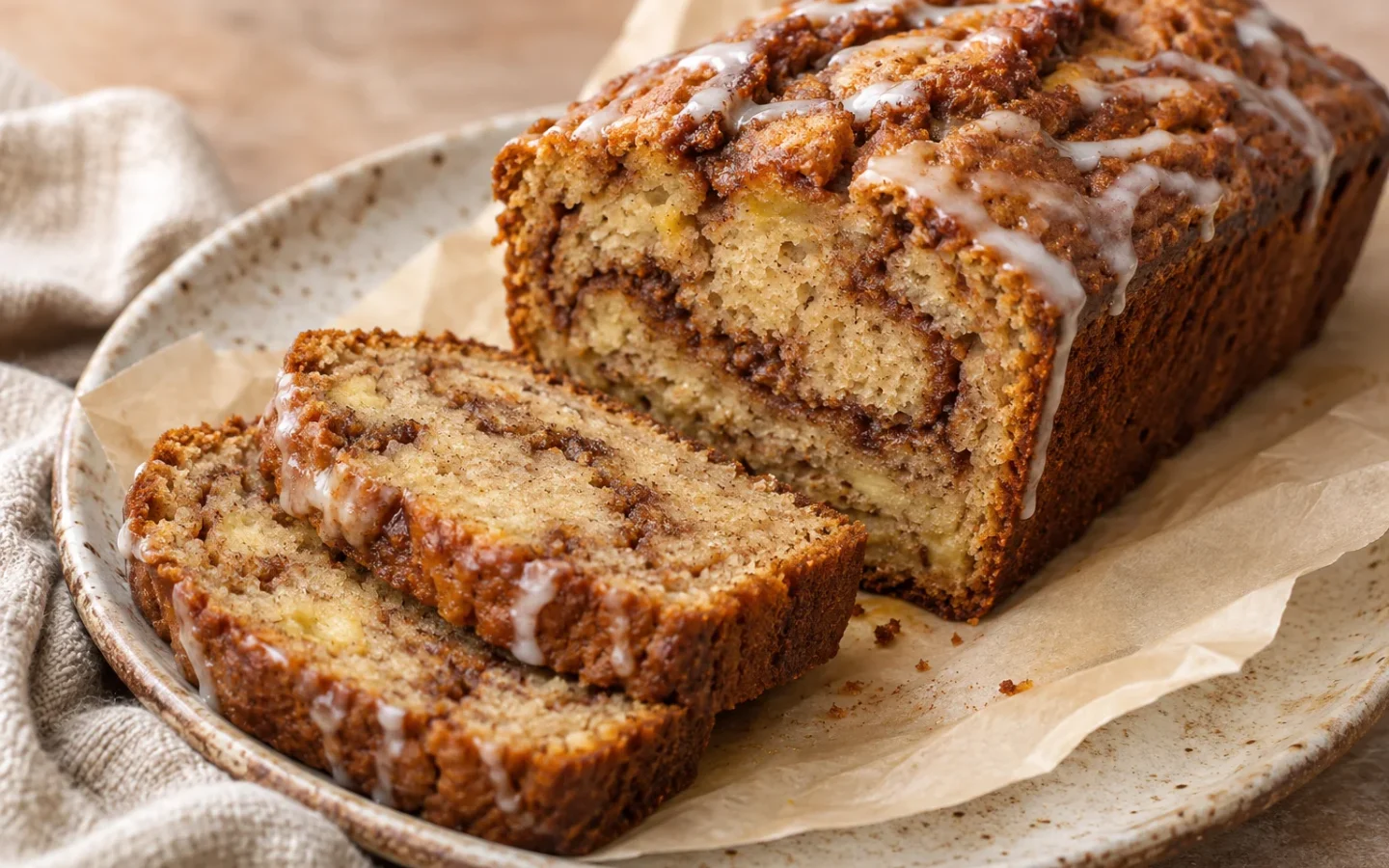
A moist banana loaf layered with a defined brown-sugar cinnamon ribbon and finished with a light cream cheese glaze that sets without soaking the crumb.
Introduction
Cinnamon roll banana bread combines the soft, fruit-sweetened crumb of a familiar quick bread with the aromatic brown-sugar ribbon people expect from a cinnamon roll. The hybrid became a strong social-media baking format in November 2026 because the cut loaf gives an immediate visual payoff: a moist interior, a visible spiral-like layer, and a pale glaze that catches the light. A dramatic slice is useful online, but the recipe still has to eat well after the camera is gone.
The central technical problem is moisture. Very ripe bananas make a tender loaf, yet too much banana or an underbaked center can turn the cinnamon layer gummy. The filling also contains sugar, which melts during baking and can separate the upper and lower layers if it is applied too thickly. This formula weighs the mashed banana, uses a modest amount of sour cream, and divides the batter so the swirl remains defined without creating a wet tunnel.
The cream cheese glaze is intentionally light. It provides the tang associated with frosted cinnamon rolls but uses enough confectioners’ sugar to set on a completely cooled loaf. Every stage includes sensory checks: how ripe the bananas should smell, what properly mixed batter looks like, where to insert the thermometer, and how long to wait before slicing. Those details make the loaf repeatable rather than merely photogenic.
Time
| Stage | Duration |
|---|---|
| Preparation time | 25 minutes |
| Cooking time | 60 minutes |
| Cooling time | 45 minutes |
| Total time | 130 minutes |
Active work takes about 25 minutes, baking generally takes 55 to 65 minutes, and the loaf needs at least 45 minutes of cooling before glazing. Oven calibration, pan material, banana moisture, and loaf dimensions can shift the clock. A dark metal pan browns faster than light aluminum, while glass holds heat longer. The loaf is done when a tester avoids the cinnamon seam and emerges with moist crumbs, or the center registers about 200°F / 93°C.
Needed equipment
| Tool | Why it helps |
|---|---|
| 8 1/2-by-4 1/2-inch metal loaf pan | Creates enough height for a clear swirl without leaving the center excessively deep. |
| Digital kitchen scale | Controls banana, flour, and sugar quantities more accurately than cups. |
| Two mixing bowls | Keeps dry ingredients separate until the wet mixture is emulsified. |
| Whisk and flexible spatula | The whisk smooths the base; the spatula folds flour without overworking gluten. |
| Parchment paper | A sling lets the delicate warm loaf lift out without breaking. |
| Instant-read thermometer or cake tester | Checks the center without relying on crust color alone. |
| Wire cooling rack | Allows steam to escape from every side before glazing. |
Tags
Banana Bread, Cinnamon Roll, Quick Bread, Cream Cheese Glaze, Viral Baking.
These tags describe the technique, central ingredients, and serving context. They are navigation aids, not guarantees for medical dietary needs; packaged products must still be checked individually.
Serving Size
This recipe yields 10 slices. Scale ingredients by weight where possible, and remember that pan area, batch size, chilling capacity, and cooking time may need to change when doubling the recipe.
Difficulty Level
Intermediate. The detailed method identifies the moments that require attention so a first-time cook can understand both the action and the intended result.
Allergen Information
Wheat, milk, and egg; possible nut cross-contact in flour, dairy, and spices depending on the manufacturer Ingredient formulas and cross-contact warnings vary by country and manufacturer. For a serious allergy, read every current label, use clean equipment, and avoid substitutions with uncertain production histories.
Dietary Preference
Vegetarian; not vegan; can be adapted with a tested gluten-free flour blend, although crumb and baking time may change
Course
Breakfast, brunch, or dessert.
Cuisine
American-inspired baking. This label describes the recipe’s culinary frame and inspiration without claiming that a modern adaptation represents every regional or traditional version.
Ingredients
| Ingredient | Amount | Selection and purpose |
|---|---|---|
| Very ripe peeled bananas | 300 g / about 3 medium | Use deeply speckled fruit; weigh after peeling and mash until mostly smooth. |
| Unsalted butter, melted | 115 g / 1/2 cup | Cool until warm rather than hot so it does not cook the egg. |
| Dark brown sugar | 135 g / 2/3 cup packed | Divided between batter and cinnamon filling for molasses flavor. |
| Granulated sugar | 50 g / 1/4 cup | Supports a tender crust and balanced sweetness. |
| Large eggs | 2 | Bring to room temperature for a smoother emulsion. |
| Sour cream | 80 g / 1/3 cup | Adds acidity and tenderness without excessive liquid. |
| Pure vanilla extract | 2 tsp | One and one-half teaspoons for batter; remainder for glaze. |
| All-purpose flour | 240 g / 2 cups spooned and leveled | Whisk before adding to distribute leaveners evenly. |
| Baking soda | 1 tsp | Reacts with sour cream and supports browning. |
| Baking powder | 1/2 tsp | Adds lift without producing a cakey crumb. |
| Fine sea salt | 3/4 tsp | Balances banana and sugar; divide a pinch into the filling. |
| Ground cinnamon | 2 1/2 tsp | Use a fragrant jar; old cinnamon tastes dusty rather than warm. |
| Cream cheese | 60 g / 2 oz | Soften fully for a lump-free glaze. |
| Confectioners’ sugar | 70 g / 2/3 cup | Sift if visibly lumpy. |
| Milk | 1 to 2 tbsp | Add gradually until the glaze falls in a thick ribbon. |
Measuring and substitution strategy
Read the entire table before shopping. The notes explain function as well as quantity, which matters when making substitutions. Replace like with like: preserve fat with fat, acidity with acidity, and structural dry ingredients with tested equivalents. Spoon measures are level US measures. When both mass and volume appear, use mass for the most repeatable result.
Prepare and measure every ingredient before heat begins. This keeps fast steps from stalling and prevents accidental double additions. If an ingredient has a variable intensity—such as chile paste, miso, coffee concentrate, or flavored liqueur—taste it alone and begin at the lower end of the suggested adjustment.
Instructions
-
1. Prepare the pan and oven
Heat the oven to 350°F / 175°C with a rack just below center. Lightly grease the loaf pan and line its long sides and base with parchment, leaving handles. Grease the exposed short ends. This combination prevents the cinnamon sugar from welding the loaf to the pan while preserving a clean crust.
-
2. Mix the cinnamon filling
Combine 50 g of the brown sugar, cinnamon, and a small pinch of the measured salt. Break every sugar lump with your fingers. The filling should be loose and evenly colored. Do not add melted butter: the batter already contains enough fat, and extra liquid encourages the center seam to separate.
-
3. Mash and measure the banana
Mash peeled banana in a large bowl, then weigh exactly 300 g. A few small pieces are welcome, but large slippery chunks create wet pockets. If the fruit is extremely watery after thawing from frozen, include the released liquid in the weight rather than pouring it into the batter unchecked.
-
4. Build the wet mixture
Whisk melted butter, remaining brown sugar, and granulated sugar into the banana. Add eggs one at a time, whisking until each disappears, followed by sour cream and 1 1/2 teaspoons vanilla. Continue for about 30 seconds until the mixture looks glossy and cohesive instead of streaked with fat.
-
5. Combine the dry ingredients
In a separate bowl, whisk flour, baking soda, baking powder, and remaining salt for at least 20 seconds. This prevents isolated pockets of soda, which can taste metallic and leave dark spots. Check the bottom of the bowl because compacted leavener often hides beneath the flour.
-
6. Fold only until combined
Add the dry mixture to the banana base in two additions. Fold with a flexible spatula, scraping the sides and bottom, until no dry flour remains. Stop immediately. The batter should be thick enough to mound briefly; vigorous stirring develops gluten and produces a rubbery strip near the base.
-
7. Layer the first half
Spread slightly less than half the batter in the pan and level it into the corners. Sprinkle two-thirds of the cinnamon mixture evenly, keeping a narrow border around the edge. The border helps the two batter layers join and prevents molten sugar from leaking directly against the pan.
-
8. Add the top and create movement
Dollop the remaining batter over the filling rather than dragging it from one end. Smooth gently, then scatter the remaining cinnamon sugar. Draw a butter knife through the batter in one shallow lengthwise S-curve. More swirling muddies the layers instead of making a prettier ribbon.
-
9. Bake and protect the crust
Bake for 55 to 65 minutes. Rotate once after 40 minutes if the oven browns unevenly. If the top becomes deeply colored before the center is ready, tent loosely with foil. Test in two places away from the wet cinnamon line; moist crumbs are acceptable, but liquid batter is not.
-
10. Cool before glazing
Rest the loaf in the pan for 15 minutes, then lift it to a rack. Cool at least 30 additional minutes. Whisk softened cream cheese, confectioners’ sugar, remaining vanilla, and one tablespoon milk until smooth. Add more milk by the teaspoon, drizzle over the cool loaf, and wait ten minutes before slicing.
Preparation Tips
- Ripen firm bananas in a paper bag at room temperature; baking unripe fruit does not create the same developed aroma.
- Use a metal pan for predictable heat transfer. If using glass, reduce the oven to 325°F / 165°C and expect a longer bake.
- Keep the cinnamon layer away from the pan walls so melted sugar does not form a hard, sticky edge.
- Do not judge doneness by a tester inserted directly into the swirl; molten brown sugar can resemble raw batter.
- Glaze only when the loaf is cool enough that the icing remains opaque and sits on top rather than disappearing into the crust.
Organization is part of the technique. Clear the work surface, keep ingredients that are ready to eat away from raw eggs or other raw proteins, and set a timer as a reminder rather than as the only doneness test. Appearance, aroma, texture, and temperature provide the final evidence.
Nutritional Information
Values are estimated per serving from the listed ingredients. Brands, absorbed oil, trimming, dilution, optional garnishes, and actual portion size change the result. This table is general information, not medical advice.
| Nutrient | Estimated amount per serving |
|---|---|
| Calories | 365 calories |
| Protein | 5 g |
| Carbohydrates | 57 g |
| Total fat | 14 g |
| Saturated fat | 8 g |
| Sodium | 310 mg |
| Dietary fiber | 2 g |
| Sugars | 34 g |
| Cholesterol | 72 mg |
For a medically prescribed diet, calculate with the exact products you use or consult a qualified clinician or registered dietitian. Sodium, sugar, caffeine, and alcohol are especially sensitive to brand and serving decisions.
Tips and Tricks
- Weigh the banana: Fruit size varies dramatically. A fixed 300 g keeps the hydration stable from loaf to loaf.
- Reserve the border: Leaving batter exposed around the filling reconnects the two layers and reduces structural splitting.
- Swirl once: One deliberate pass creates contrast; repeated stirring dissolves the cinnamon pattern into a uniformly brown crumb.
- Use two doneness checks: Combine internal temperature with a tester placed away from the sugar seam for a more reliable decision.
Add-ons
Choose one variation at a time so the core balance remains clear.
- Toasted pecans: Fold 75 g chopped toasted pecans into the batter for crunch, and disclose the tree-nut allergen clearly.
- Chocolate chips: Add 85 g semisweet chips, but reduce the glaze by half so the loaf does not become excessively sweet.
- Orange zest: Rub one teaspoon finely grated zest into the sugar for brightness that cuts through banana richness.
- Coffee glaze: Replace one tablespoon milk with cooled espresso for a breakfast-friendly bitter note.
Side dishes
Pair the recipe with contrast rather than more of the same dominant flavor.
- Plain Greek yogurt: Tangy, unsweetened yogurt balances the glazed loaf and adds protein to breakfast.
- Fresh berries: Their acidity and firm texture contrast with the soft, sweet crumb.
- Black coffee: A clean bitter drink keeps a rich slice from feeling heavy.
- Soft scrambled eggs: For brunch, a savory egg dish turns one slice into part of a complete meal.
Improvements
Use the finished result as evidence. Diagnose the specific issue before changing the next batch, and change one major variable at a time.
- The center is gummy: The loaf may be underbaked, overfilled with banana, or sliced hot. Weigh the fruit, test away from the swirl, and cool fully.
- The swirl separates: The filling was too thick or reached the pan edge. Use the measured amount and preserve a clean batter border.
- The crumb is tough: Flour was overmeasured or the batter was mixed too long. Weigh flour and stop folding when the final streak disappears.
- The glaze turns transparent: The loaf was warm or the icing too thin. Cool completely and add confectioners’ sugar until it ribbons rather than runs.
Save and store
Store the unglazed loaf tightly wrapped at room temperature for up to two days. Because the glaze contains cream cheese, refrigerate a glazed loaf in an airtight container and use within four days. Bring individual slices to room temperature for 20 minutes or warm them for a few seconds so the butter softens. To freeze, omit the glaze, wrap the whole cooled loaf or individual slices in plastic and foil, and freeze for up to three months. Thaw overnight in the refrigerator, then add fresh glaze after the surface is dry.
Label stored components with the date and use clean, shallow containers where rapid cooling is needed. When handling history, time, temperature, or odor is uncertain, discard the food rather than relying on reheating to make it safe.
FAQ
Can I use frozen bananas?
Yes. Thaw them in a bowl and include both fruit and released liquid when weighing the 300 g portion. If the mixture seems exceptionally watery, simmering is not recommended; choose a different batch of bananas.
Why did the loaf sink in the center?
Common causes include underbaking, expired leavener, too much banana, or opening the oven early. Verify oven temperature and wait until the structure is nearly set before rotating.
Can I make muffins with this batter?
Yes. Divide among lined muffin cups, layer a small amount of cinnamon filling in each, and begin checking around 20 minutes. Do not overfill because the sugar seam can overflow.
Can I omit the cream cheese glaze?
Absolutely. The bread is complete without it. A light dusting of confectioners’ sugar or no topping keeps the loaf less sweet and simplifies room-temperature storage.
How ripe should the bananas be?
The peel should show abundant brown speckles and the fruit should smell strongly sweet without a fermented or alcoholic odor. Green-edged fruit lacks enough developed flavor.
Can I prepare the batter the night before?
No. Baking soda begins reacting as soon as wet and dry ingredients meet. Bake immediately, then store the cooled loaf; that preserves lift much better than holding raw batter.
Conclusion
A reliable cinnamon roll banana bread is a moisture-management recipe disguised as a simple mash-and-bake loaf. Weigh ripe banana, mix the batter gently, keep the cinnamon filling controlled, and test the crumb away from the molten seam. After complete cooling, the tangy glaze can sit visibly on the crust while every slice retains a clean brown-sugar ribbon. The result delivers the visual drama of the trend and the balanced texture needed for a loaf worth baking again.
References
References support trend, safety, or ingredient context. The recipe proportions, editorial explanations, troubleshooting, and serving guidance are original to Love With Recipes.