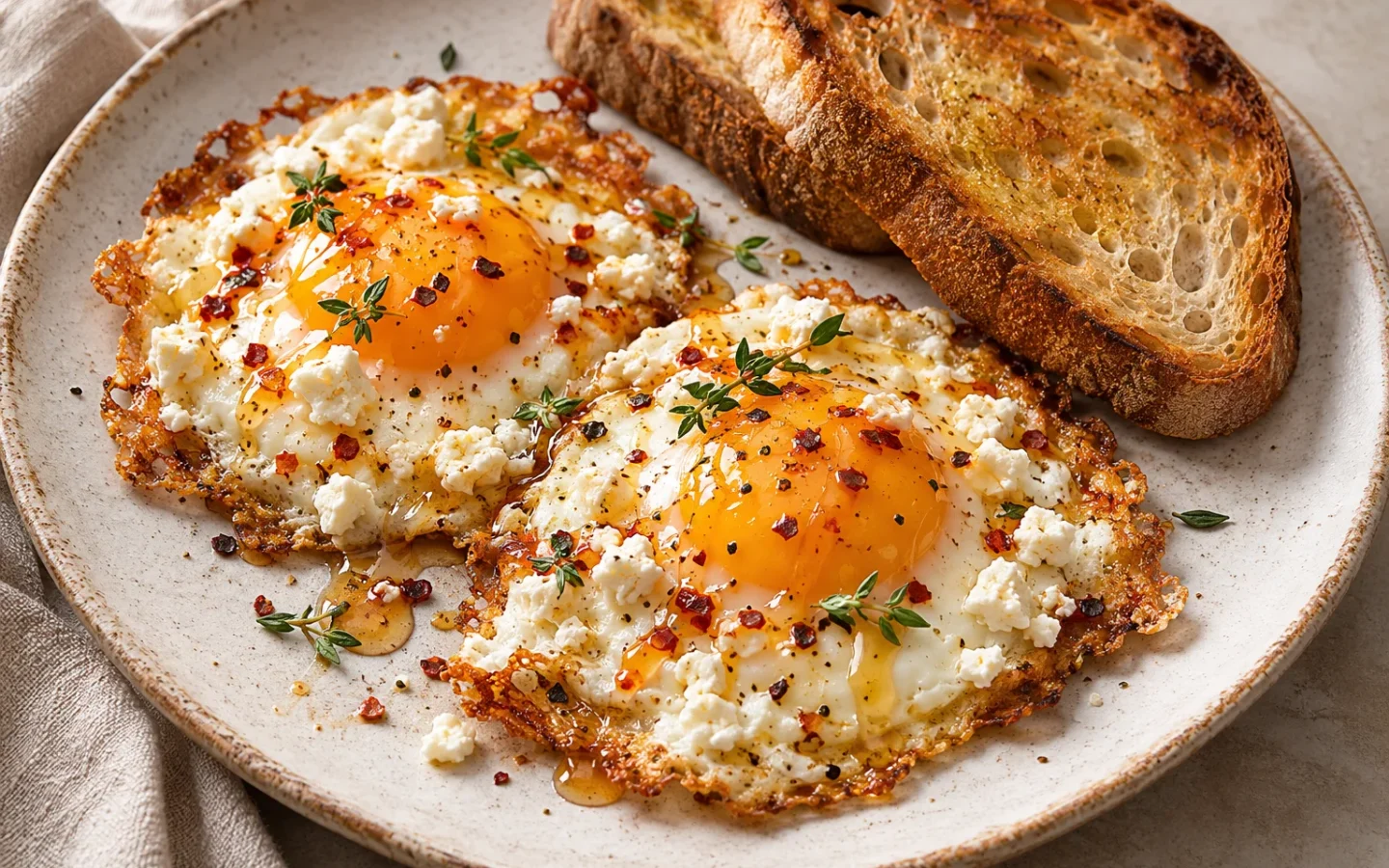
Crisp-edged fried eggs set over a savory feta crust and finished with a controlled drizzle of sweet, spicy hot honey.
Introduction
Hot honey feta eggs combine three strong ideas in one small skillet: salty cheese, browned egg edges, and a glossy sweet-spicy finish. Feta melts differently from mozzarella or cheddar. It softens, sizzles in its brine and fat, and browns into a delicate crust around the egg rather than stretching. That crust is the foundation of the recipe, not just a garnish.
The sweet-spicy or “swicy” flavor profile continued to expand through breakfast menus and home cooking in 2026. Here, it works because honey rounds the sharp saltiness of feta while chile cuts through yolk richness. The portion must stay controlled. One to two teaspoons of hot honey for two eggs is enough to glaze the surface without turning breakfast into dessert.
This method gives clear heat cues for crisp whites and yolks cooked to preference. It also includes a quick homemade hot honey, although a purchased version works. You can serve the eggs on sourdough, tuck them into a pita, or place them over greens. Whichever route you choose, prepare the plate first: the eggs are at their best in the minute after they leave the pan.
Time
| Stage | Duration |
|---|---|
| Preparation time | 8 minutes |
| Cooking time | 8 minutes |
| Total time | 16 minutes |
Preparation takes about eight minutes and skillet cooking another six to eight. The pace is quick once the feta hits the pan, so toast bread and arrange any sides before cracking the eggs. A covered skillet sets the surface efficiently but can cloud the yolks; leaving it uncovered keeps the yolks vivid but demands gentler heat and a slightly longer cook. Room-temperature eggs spread less abruptly than ice-cold eggs, yet cold eggs still work.
Needed equipment
| Tool | Why it helps |
|---|---|
| 10-inch nonstick or well-seasoned skillet | Provides room for two eggs without forcing the whites together. |
| Thin flexible spatula | Slides beneath the feta crust without tearing it. |
| Small saucepan or microwave-safe cup | Needed only for homemade hot honey. |
| Two small bowls | Cracking eggs separately catches shell and protects the pan from a broken yolk. |
| Lid that fits the skillet | Optional for a firmer top or fully set yolk. |
Tags
Hot Honey, Feta Eggs, Breakfast Recipes, Brunch, Sweet and Spicy.
These tags describe the technique, central ingredients, and serving context. They are navigation aids, not guarantees for medical dietary needs; packaged products must still be checked individually.
Serving Size
This recipe yields 2 servings. Scale ingredients by weight where possible, and remember that pan area, batch size, chilling capacity, and cooking time may need to change when doubling the recipe.
Difficulty Level
Easy. The detailed method identifies the moments that require attention so a first-time cook can understand both the action and the intended result.
Allergen Information
Egg and milk; possible gluten when served with bread; honey is not suitable for infants under 12 months Ingredient formulas and cross-contact warnings vary by country and manufacturer. For a serious allergy, read every current label, use clean equipment, and avoid substitutions with uncertain production histories.
Dietary Preference
Vegetarian; naturally low in carbohydrates without toast; gluten-free when served with certified gluten-free bread or vegetables
Course
Breakfast or brunch.
Cuisine
Modern Mediterranean-inspired. This label describes the recipe’s culinary frame and inspiration without claiming that a modern adaptation represents every regional or traditional version.
Ingredients
| Ingredient | Amount | Selection and purpose |
|---|---|---|
| Large eggs | 4 | Use fresh eggs for compact whites; crack each into a separate cup. |
| Feta cheese | 100 g / 3 1/2 oz | Pat dry and crumble into pea-size pieces; block feta browns better than very wet pre-crumbled cheese. |
| Extra-virgin olive oil | 2 tsp | Helps the feta and whites crisp without scorching. |
| Honey | 2 tbsp | For homemade hot honey; use a mild floral honey. |
| Crushed red pepper flakes | 1/2 to 1 tsp | Adjust heat to taste; flakes continue infusing as they sit. |
| Apple cider vinegar | 1/2 tsp | A small acidic note keeps the honey bright rather than sticky-sweet. |
| Freshly ground black pepper | 1/4 tsp | Feta supplies enough salt for most palates. |
| Fresh thyme or oregano | 1 tsp leaves | Optional aromatic finish. |
| Sourdough bread | 4 slices | Toast before cooking the eggs so it is ready at once. |
| Lemon wedge | 1 | Optional; a few drops wake up a rich plate. |
Measuring and substitution strategy
Read the entire table before shopping. The notes explain function as well as quantity, which matters when making substitutions. Replace like with like: preserve fat with fat, acidity with acidity, and structural dry ingredients with tested equivalents. Spoon measures are level US measures. When both mass and volume appear, use mass for the most repeatable result.
Prepare and measure every ingredient before heat begins. This keeps fast steps from stalling and prevents accidental double additions. If an ingredient has a variable intensity—such as chile paste, miso, coffee concentrate, or flavored liqueur—taste it alone and begin at the lower end of the suggested adjustment.
Instructions
-
1. Make the hot honey
Warm honey and red pepper flakes over the lowest heat for two minutes, just until fluid and fragrant. Do not boil; high heat dulls honey aroma and can make it dangerously hot. Remove from the burner, stir in vinegar, and rest while you cook. For milder heat, strain out the flakes after five minutes.
-
2. Dry and crumble the feta
Blot feta with a clean towel, then crumble it into small uneven pieces. Very wet feta steams before it browns, while powdery crumbs can burn. Aim for pea-size pieces with a few smaller bits that will melt into a connected lace around the egg.
-
3. Prepare the eggs and plate
Crack each egg into its own small bowl so you can lower it close to the pan and remove stray shell. Toast the bread, place serving plates nearby, and set herbs and honey within reach. Once the whites are done, delaying service makes the yolks continue cooking.
-
4. Heat the skillet gradually
Place the skillet over medium heat for one minute, then add olive oil and swirl. The oil should shimmer but not smoke. A pan that is too cold makes greasy, pale cheese; one that is too hot scorches feta before the egg white can set.
-
5. Build two feta rings
Divide half the feta into two loose rings, each slightly wider than an egg. Leave an open center and scatter a few crumbs inside. Let the cheese sizzle for 30 to 45 seconds until moisture evaporates and the undersides begin turning golden.
-
6. Add the eggs
Lower one egg into each feta ring, keeping the yolk near the center. Scatter the remaining feta over thin areas of white but do not bury the yolks. Season with black pepper. Skip extra salt until tasting because feta varies widely in salinity.
-
7. Control the white and edge
Cook uncovered over medium-low heat until the outer white is opaque and the feta edge is golden, about three minutes. If the underside colors too fast, slide the pan off heat for 20 seconds. Rotate the skillet so the whites cook evenly over any hot spot.
-
8. Choose the yolk finish
For runny yolks, cook until the whites near the yolk have only a slight translucent sheen. For medium yolks, cover for 30 to 60 seconds. For fully set eggs, add a teaspoon of water away from the eggs, cover, and steam gently until no liquid yolk remains.
-
9. Release the feta crust
Run a thin spatula around each egg, then work underneath the browned cheese in short movements. If it resists, wait 15 seconds; well-browned feta releases more willingly than pale cheese. Transfer directly to toast or plates without stacking.
-
10. Finish with restraint
Drizzle each serving with one to two teaspoons hot honey, sprinkle with herbs, and add a few drops of lemon if desired. Taste a piece containing yolk, feta, and honey before adding salt or more chile. Serve immediately while the edges still crackle.
Preparation Tips
- Block feta stored in brine usually has fuller flavor, but it must be thoroughly blotted before frying.
- Use a broad spatula and allow browning to create release. Scraping too early tears the cheese lace.
- Keep the honey warm, not hot. Microwave in five-second bursts if it thickens before service.
- Fresher eggs have tighter whites. If the outer white is very watery, strain it briefly through a fine sieve before cooking.
- To serve four people, use two skillets or cook in batches and keep the first batch only briefly in a 200°F / 95°C oven.
Organization is part of the technique. Clear the work surface, keep ingredients that are ready to eat away from raw eggs or other raw proteins, and set a timer as a reminder rather than as the only doneness test. Appearance, aroma, texture, and temperature provide the final evidence.
Nutritional Information
Values are estimated per serving from the listed ingredients. Brands, absorbed oil, trimming, dilution, optional garnishes, and actual portion size change the result. This table is general information, not medical advice.
| Nutrient | Estimated amount per serving |
|---|---|
| Calories | 345 calories |
| Protein | 19 g |
| Carbohydrates | 20 g |
| Total fat | 22 g |
| Saturated fat | 9 g |
| Sodium | 720 mg |
| Dietary fiber | 1 g |
| Sugars | 18 g |
| Cholesterol | 390 mg |
For a medically prescribed diet, calculate with the exact products you use or consult a qualified clinician or registered dietitian. Sodium, sugar, caffeine, and alcohol are especially sensitive to brand and serving decisions.
Tips and Tricks
- Let feta do the seasoning: Wait until the finished bite is tasted before adding salt; cheese salinity can differ substantially.
- Use visual heat cues: The oil should shimmer, the feta should sizzle steadily, and the cheese should brown over minutes rather than seconds.
- Protect the crisp edge: Do not cover longer than necessary, and move the eggs directly to a dry plate or toast instead of a wet sauce.
- Balance all three elements: A forkful should contain egg, feta, and a trace of honey. More honey is not automatically more flavor.
Add-ons
Choose one variation at a time so the core balance remains clear.
- Avocado: Fan half an avocado beside the eggs and add lemon. Its cool creaminess softens chile without diluting the feta crust.
- Wilted spinach: Cook spinach separately and squeeze out excess liquid before plating; moisture placed under the eggs softens the crisp base.
- Tomato and cucumber salad: A lightly dressed chopped salad turns the recipe into a fuller Mediterranean-style brunch.
- Pita breakfast pocket: Break a well-set egg into a warm pita with greens and yogurt. Use a firmer yolk to reduce dripping.
Side dishes
Pair the recipe with contrast rather than more of the same dominant flavor.
- Sourdough toast: Its sturdy crumb catches yolk and honey while keeping a crisp edge.
- Lemony arugula: Peppery leaves and acid cut the combined richness of cheese and egg.
- Roasted breakfast potatoes: Keep their seasoning simple so they can absorb a little hot honey without competing.
- Plain Greek yogurt: Serve on the side, not beneath the eggs, to preserve crispness.
Improvements
Use the finished result as evidence. Diagnose the specific issue before changing the next batch, and change one major variable at a time.
- Feta will not brown: It may be too wet, the pan may be crowded, or heat may be low. Blot the cheese, use a wider skillet, and wait for moisture to evaporate.
- Cheese burns before whites set: Reduce the burner and begin with a less aggressively preheated pan. A brief lid finish is safer than increasing bottom heat.
- Whites spread everywhere: Use fresher eggs, crack into cups, and form defined feta rings. A small skillet also limits spreading.
- Breakfast tastes too sweet: Use less honey, increase vinegar by a few drops, and add bitter greens. Do not compensate with excessive salt.
Save and store
Fried eggs are best eaten immediately. If leftovers are unavoidable, cool them promptly, refrigerate in a shallow airtight container, and use within one day. Reheat gently in a covered skillet over low heat until hot; the yolk will become firmer and the edge will lose some crispness. Homemade hot honey can be stored in a clean sealed jar at room temperature for about one month when made only with shelf-stable ingredients. If fresh chile, garlic, or herbs are added, refrigerate instead and use promptly. Never give honey to a child younger than 12 months.
Label stored components with the date and use clean, shallow containers where rapid cooling is needed. When handling history, time, temperature, or odor is uncertain, discard the food rather than relying on reheating to make it safe.
FAQ
Can I use pre-crumbled feta?
Yes, but check its texture. Very dry crumbs may brown quickly without forming a connected crust, while wet crumbs need blotting. Block feta usually gives a more varied and attractive lace.
Can I use store-bought hot honey?
Absolutely. Taste it before pouring because heat and sweetness vary. Start with one teaspoon per serving and add more only after tasting the complete bite.
How do I cook the yolk fully without burning the feta?
Lower the heat, add a teaspoon of water to an empty part of the pan, and cover. Gentle steam finishes the top while the burner stays low enough to protect the cheese.
Can I make this dairy-free?
Feta is central to the crust, so a dairy-free feta-style product will give a different melt. Choose a firm, salty product, pat it dry, and test one egg first because formulations vary.
Are runny yolks safe for everyone?
Runny eggs carry more risk than fully cooked eggs. Pregnant people, young children, older adults, and immunocompromised diners should follow local health guidance and consider pasteurized eggs cooked until firm.
Can I prepare the recipe ahead?
Mix the hot honey and crumble the feta in advance, but fry the eggs at serving time. The crisp cheese edge does not hold well once refrigerated or covered.
Conclusion
Hot honey feta eggs succeed through heat control and proportion. Dry feta forms the salty crisp foundation, gently cooked eggs supply richness, and a small drizzle of chile-infused honey joins them without taking over. Prepare the plate first, watch the pan rather than the clock alone, and serve the moment the whites are set to your liking. The result is fast enough for a weekday but distinctive enough for brunch.
References
References support trend, safety, or ingredient context. The recipe proportions, editorial explanations, troubleshooting, and serving guidance are original to Love With Recipes.